BT Video Baby Monitor 6000: A UK Buyer's Guide
An evidence-led guide to the BT Video Baby Monitor 6000, covering its 5-inch screen, range, night vision, talkback, setup and honest limitations.
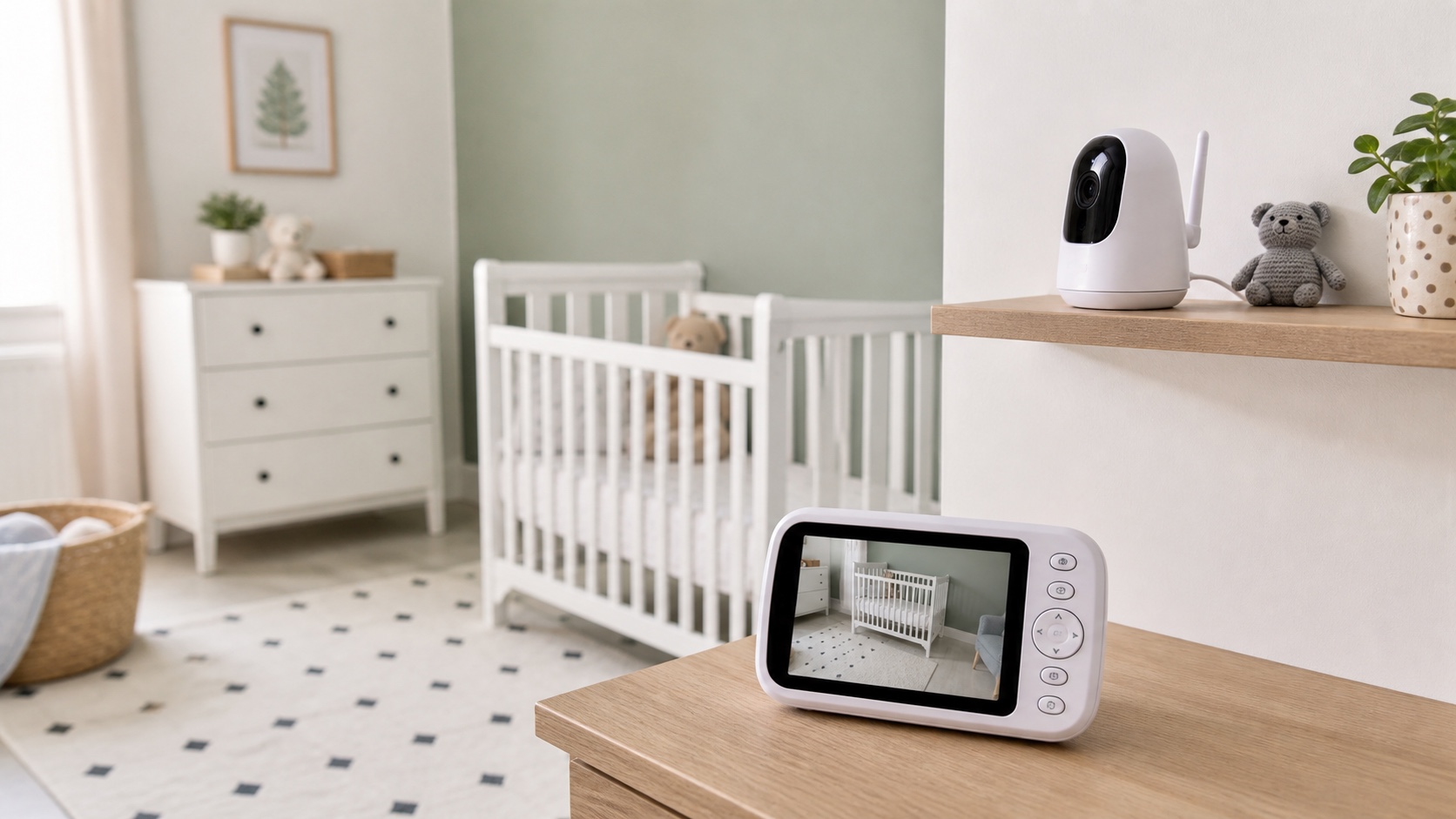
The BT Video Baby Monitor 6000 is a dedicated, non-app video monitor built around a 5-inch parent-unit screen. BT’s published specification lists night vision, two-way talk, temperature indication, five lullabies, sound-level lights and a maximum range of about 250 metres outdoors or 50 metres indoors.
Its strongest fit is a household that wants a separate parent unit rather than relying on a phone and home Wi-Fi. Its limitations are equally important: the display resolution is modest by current phone standards, the parent-unit battery is sealed, and real indoor range depends heavily on walls and interference.
What the BT 6000 is, and is not
The system contains a baby unit with camera and a portable parent unit with its own screen. BT identifies the radio technology as digital FHSS at 2.4 GHz. That is different from a Wi-Fi camera accessed through a mobile app.
The dedicated connection means ordinary home-internet failure is not part of the viewing path. It does not mean the signal is immune to thick walls, metal structures, microwave ovens or other 2.4 GHz equipment. BT’s troubleshooting advice tells users to move the units closer and away from electrical devices when the link is unreliable.
This monitor is an aid. BT’s guide states that it is not a substitute for responsible adult supervision. It does not diagnose illness, prevent SIDS or replace safe-sleep guidance.
Published specifications
| Feature | BT’s published information |
|---|---|
| Parent screen | 5-inch colour display |
| Display resolution | 480 x 272 |
| Radio | Digital FHSS, 2.4 GHz |
| Maximum quoted range | 250 m outdoors, 50 m indoors |
| Camera view | 40-degree lens viewing angle |
| Movement | Motorised remote pan; manual/digital tilt and zoom wording |
| Night use | Night vision and sound-level lights |
| Audio | Microphone, speaker, adjustable volume and two-way talk |
| Other functions | Temperature indication and five lullabies |
| Parent-unit battery | 2100 mAh lithium-ion, sealed/non-user-replaceable |
| Parent-unit size/weight | 96 x 164 x 19 mm; 216 g |
| Baby-unit size/weight | 152 x 85 x 85 mm; 128 g |
Specifications identify capabilities, not the quality of the picture in your nursery or the usable range through your walls. Treat the outdoor figure as a best-case reference, not a promise for a multi-storey house.
Who should consider it?
The BT 6000 makes sense when you value:
- a screen that remains dedicated to monitoring;
- operation without a phone notification stack;
- two-way talk and remote camera pan;
- visible sound-level lights when audio is low;
- a straightforward non-Wi-Fi category.
Read the site’s non-Wi-Fi baby monitor guide if that category choice is still open. If you need two cameras shown together, compare the exact multi-camera support rather than assuming a large screen provides split-screen; the split-screen guide explains that distinction.
It is a weaker fit if you require remote viewing away from home, phone alerts, cloud clips, a high-resolution display or a user-replaceable battery. Those are different buying requirements, not defects hidden by the model name.
Safe placement and first setup
BT’s quick-start guide says the baby unit should be at least one metre from the baby and near a power socket. Keep the unit and every cable outside the cot, bed and playpen, with spare cable length secured out of reach. Do not cover vents or put either unit in a damp place.
For the first setup:
- Inspect both power supplies, cables and cases for damage.
- Put the parent unit at least one metre from the baby unit to reduce feedback.
- Charge the parent unit for the period stated in the current guide before relying on battery operation.
- Confirm picture, sound, talkback, night vision and temperature display.
- Walk the actual route through the home and identify the first weak-signal area.
- Test low-battery and out-of-range indications while another adult remains with the baby.
The temperature display is a sensor reading, not a complete assessment of sleep safety. Check room conditions and bedding using current professional guidance.
Picture, pan and night use
The 5-inch screen is physically generous for a dedicated monitor, but the published 480 x 272 resolution is lower than modern phone displays. Judge whether it gives enough detail at your normal viewing distance rather than expecting HD sharpness.
Remote motorised pan is useful when the camera covers a wider play or sleep area. Position it so that the useful movement range shows the cot without pointing through bars, hanging fabric or a bright window. Digital zoom enlarges pixels; it does not add detail that the camera did not capture.
Test night vision in the actual dark room. Reflections from glossy furniture or a nearby wall can wash out the image even when the camera works correctly.
Range and interference
The quoted 250 m outdoor and 50 m indoor figures are maximums under favourable conditions. Stone walls, foil-backed insulation, metal frames, floors and neighbouring radio equipment can reduce usable range.
If the parent unit beeps or loses the image, BT recommends moving it closer and moving both units away from large obstructions and electrical devices. Do not solve a weak link by moving the baby unit within reach of the cot.
Perform a room-by-room test before the return deadline. Include the garden, kitchen or loft room only if you genuinely need coverage there.
Buying a current or used unit
BT still hosts product help, specifications and troubleshooting documents, but a support page does not prove that new retail stock is current or authorised. Verify seller identity, condition, warranty, included power supplies and return terms.
For a used unit, inspect the sealed parent-unit battery carefully. Ask how long it runs away from mains, check that both units pair, and confirm that the supplied adaptors match BT’s documentation. A tired sealed battery can turn a portable parent unit into a mains-only device.
Do not mix apparently similar BT monitor families. BT’s troubleshooting page says the 2000, 3000, 4000, 5000 and 6000 models do not link with the newer Smart 2.8-inch or 5-inch monitor family even when products look similar.
The site’s smart-sock buying guide covers a separate category. Biometric wearables should not be presented as a simple upgrade from a video monitor, and neither category should make medical guarantees.
A practical decision checklist
- Is a dedicated parent screen more important than remote app access?
- Does the exact box include both correct power supplies?
- Can the camera remain at least one metre from the baby with all cables secured?
- Does the signal cover the rooms you will actually use?
- Is the sealed battery healthy enough for your routine?
- Are picture detail and night vision adequate in your room?
- Are the seller, warranty and return route documented?
If any of these fails, choose another model category rather than trying to make the BT 6000 answer a job it was not designed for.
FAQ
Does the BT Video Baby Monitor 6000 use Wi-Fi?
BT describes it as a digital FHSS 2.4 GHz monitor with a dedicated parent unit. It is not presented as a phone-app Wi-Fi camera.
What is the range?
BT quotes up to 250 m outdoors and 50 m indoors. Walls and interference can reduce that substantially, so test your home.
Can I replace the parent-unit battery myself?
BT’s documentation says the lithium-ion battery is sealed and not user-replaceable. Use the recommended support route for repair or replacement advice.
Does it have night vision and talkback?
Yes. Both appear in BT’s official product details and specification sheet.
Can it prevent SIDS or diagnose a medical problem?
No. It is a monitoring aid and cannot replace responsible adult supervision, safe-sleep practice or medical care.